Your AI Enablement Strategy Is Either Too Slow or Too Fragile
by James Barton
The other week, in a car park just outside Birmingham, I had one of those moments that sticks with you.
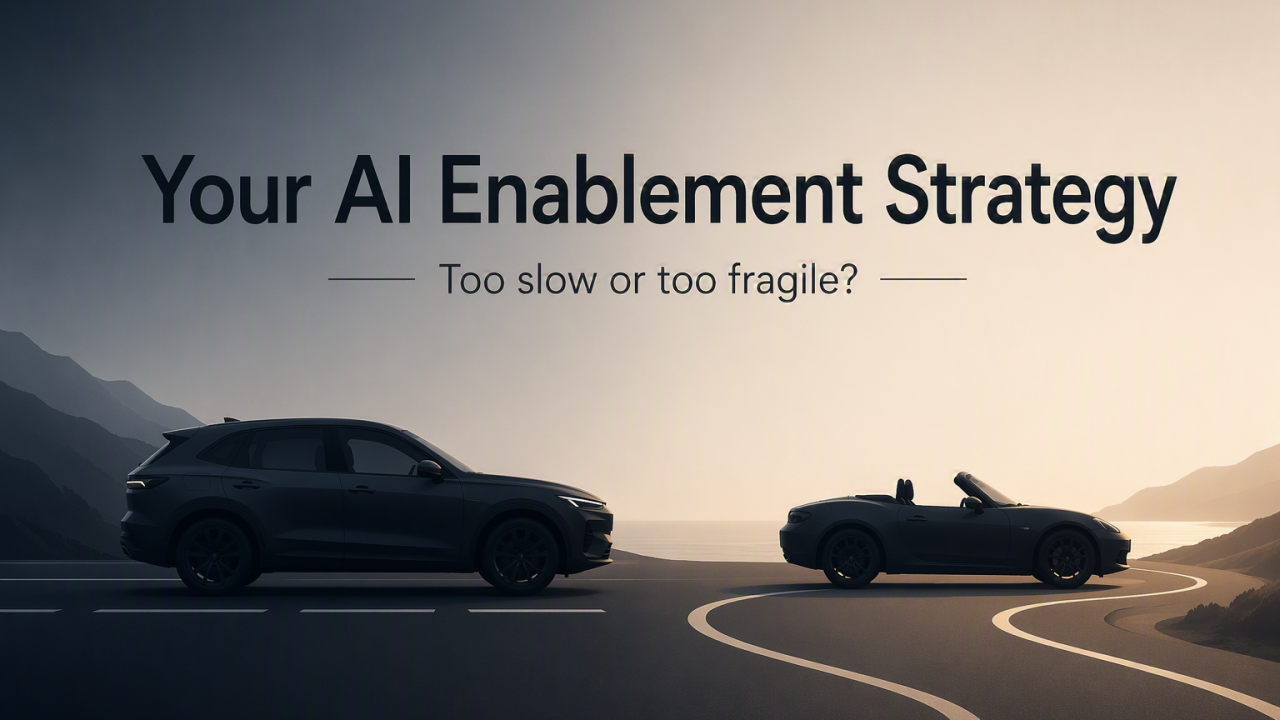
A fellow director and I were heading back to the motorway after a client visit. He climbed into a large, beautifully engineered electric SUV. I got into my small, lightweight two-seater convertible.
As we pulled out, the contrast was obvious.
His car was technically superior. More power, more systems, more refinement. In a straight line, it would leave mine behind without breaking a sweat.
But in the tight turns of the car park, the roundabouts, the short bursts of acceleration and braking, mine was simply more agile. It responded faster. It adapted quicker. It felt built for the moment.
And it struck me that this is exactly what is happening with AI in Sales Enablement organisations right now.
Two models, one problem.
In sales enablement, I’m seeing many organisations utilise one of two main approaches to AI.
One approach involves large organisations developing “SUVs”:
- Highly engineered platforms
- Robust governance and compliance measures
- Substantial investments with stakeholder alignment
- Extended development timelines
These systems are powerful. When they work, they scale brilliantly. But they are often slow to adapt and struggle to respond to immediate commercial needs.
On the other hand, smaller organisations or individual teams within larger companies are developing “two seaters”:
- Lightweight, agile use cases
- Quick experimentation
- Close connection to actual sales challenges
- Rapid iteration based on feedback
These are agile. They create momentum. They often deliver value quickly.
But they lack durability. They do not always scale. And they can create fragmentation if left unchecked.
The mistake: treating this as a choice
Understandably, organisations treat these approaches as mutually exclusive. Do we build something robust and scalable or do we experiment and move fast? Unfortunately, this is a mistake. The reality is you need both.
McKinsey states that organisations effectively balancing experimentation with structured scaling are much more likely to achieve measurable AI value. However, most companies tend to favour one approach: either over-engineering without confirming value or experimenting persistently without integrating impact.
In sales enablement, that tension is even more pronounced because ultimately, we are not building AI for its own sake. We should be building systems that improve sales performance, pipeline, conversion, deal velocity, and revenue outcomes.
And those systems require both agility and structure.
Want to read the full article? Click here