
Don’t Replace The Person. Redesign The Work.
by James Barton
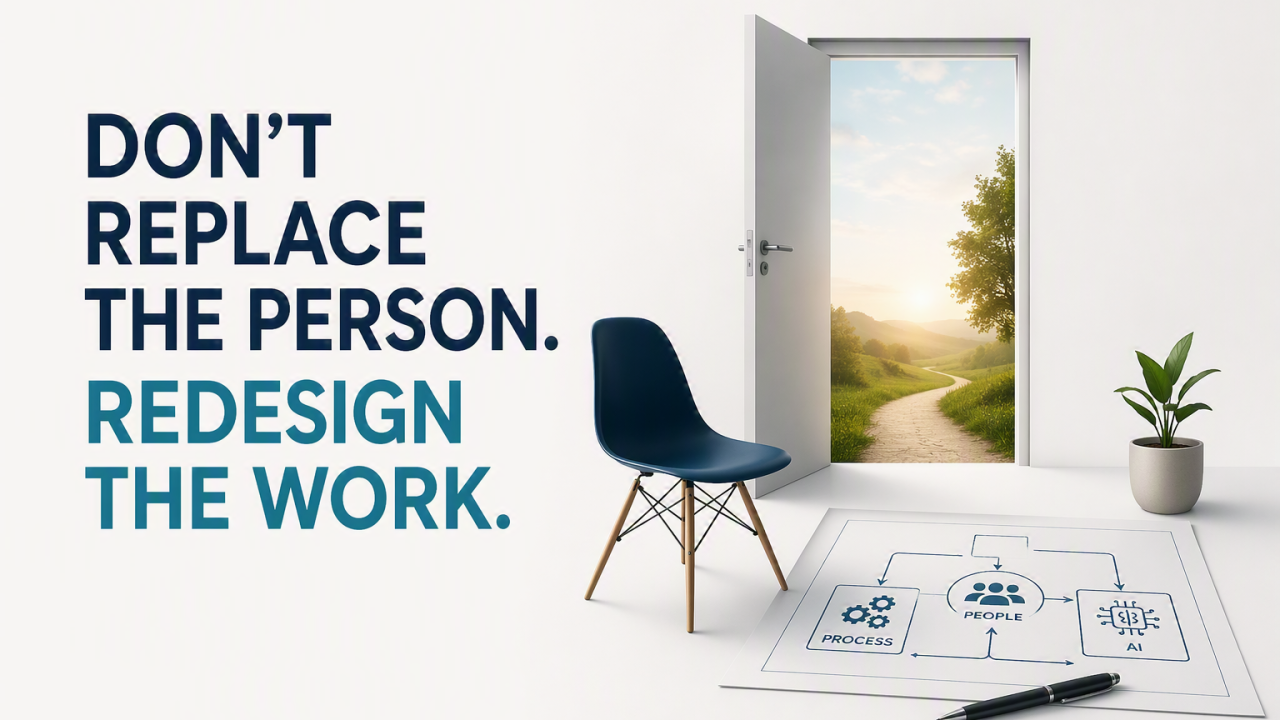
James Barton argued in a recent article that when someone leaves the business, the default response is usually to replace the person. That got us thinking about a more useful question: what if a resignation is not just a hiring problem to solve, but a rare opportunity to rethink how the work should be done in the first place?
Why vacancies are one of the best moments to rethink work
Most leaders know the feeling.
A valued team member asks for five minutes. You can sense where the conversation is heading before they sit down. Even for experienced managers, resignations can feel like a setback, especially when the person is talented, trusted, and clearly part of the organisation’s future.
But James makes an important point: the real mistake often comes after that moment.
In many organisations, the next step is automatic. Review the job description. Open recruitment. Find someone with similar skills to do the same job in the same structure. The role existed yesterday, so the assumption is that it must still be needed tomorrow.
That assumption is becoming harder to defend.
As AI changes how work gets done, many jobs are being exposed for what they really are: not fixed roles, but collections of tasks that have built up over time. Some of those tasks still create real value. Others only exist because systems are fragmented, information is hard to find, reporting is manual, or workflows were designed before today’s tools were available.
A resignation creates something organisations rarely get on purpose: permission to pause.
Why roles are often older than the work they contain
Most organisations do not design roles from scratch very often. They inherit them.
Responsibilities accumulate. New tasks are added. Old tasks stay in place. Reporting lines remain even when the work changes. Over time, the role starts to feel fixed, even when the conditions around it have moved on.
That matters more now because AI is not only changing productivity. It is changing what needs human effort at all.
Drafting, summarising, analysing, surfacing knowledge, automating workflows, and supporting decisions can all now be done differently from even a few years ago. So when a role becomes vacant, leaders have a genuine strategic choice to make: are they replacing a person, or are they redesigning the work?
Those are not the same decision.
The cost of treating every vacancy as a like-for-like hire
The safest-looking choice is often the most expensive one.
Replacing someone exactly as they were can preserve continuity in the short term, but it can also lock in outdated processes for years. It assumes that the work was already designed well. It assumes the mix of tasks still makes sense. It assumes the skill profile is unchanged. It assumes the team structure is still right.
In an AI-shaped environment, those assumptions deserve more challenge than they usually get.
James puts it well: if we were designing the role today, with access to tools that can draft content, analyse data, surface knowledge, automate workflows and support decision-making, would we still create the same position in the same form? Would the same responsibilities sit together? Would the same number of people be involved? Would the same skills matter most?
These are uncomfortable questions because they force leaders to separate familiar work from necessary work.
Why resignations create a rare window for change
What makes this moment useful is that organisational inertia briefly weakens.
When someone leaves, teams already expect change. Work is redistributed. Temporary fixes appear. People question how things will be covered. This creates a short period where assumptions are easier to challenge because the system is already moving.
That makes resignations unusually valuable from a design perspective.
Instead of asking only, “Who can do this job?”, leaders can ask:
1. Which parts of this role create the most value?
Some tasks directly drive outcomes. Others exist because of friction elsewhere in the system.
2. Which tasks should still be done by people?
Human judgement, relationship-building, context and accountability still matter enormously. But not every recurring task needs the same level of human effort.
3. Which tasks could be simplified, automated or supported by AI?
AI can remove low-value manual effort, accelerate preparation, improve access to knowledge, and reduce time spent on repetitive tasks.
4. Does this role still need the same shape?
The answer may be yes. But it may also point to a different skill mix, a narrower remit, a broader capability, or a completely new role.
These questions shift the discussion from replacement to redesign.
What better role redesign looks like
James notes that some of the most encouraging examples come when leaders step back before rehiring. Sometimes that means changing the skill profile. Sometimes it means creating a new kind of role. More often, it means designing a better combination of people, process and AI than was possible before.
That is a far more useful way to think about workforce planning.
1. Start with outcomes, not headcount
What does the business actually need this role to achieve now? Begin there, not with the old job description.
2. Map the work into tasks
Break the role into the tasks it contains. This makes it easier to see which work is strategic, which is repetitive, and which exists only because of broken process.
3. Decide where human effort adds the most value
Not every task deserves the same level of time, skill or attention. Focus people where judgement and impact are highest.
4. Use AI to redesign the flow of work
The goal is not simply to bolt AI onto the old role. It is to ask how the role changes when information, drafting, coordination and analysis can happen differently.
5. Hire for the future shape of the work
If a role is worth filling, fill it based on the work as it should now be done, not as it happened to be done before.
Why this matters beyond HR
This is not only a talent issue. It is an operating model issue.
Every like-for-like replacement is also a decision about process, structure and productivity. It says something about whether the organisation is willing to re-examine how value is created, or whether it prefers to protect continuity even when the environment has changed.
That matters because many organisations still have teams covering for inefficiencies that should already have been removed. People search for information because knowledge is scattered. They manually compile reports because systems do not connect. They spend time updating spreadsheets because the process has never been redesigned.
In those situations, hiring another person into the same role does not solve the real problem. It simply funds it for longer.
The leadership shift this requires
The hardest part is not analytical. It is emotional.
When strong people leave, leaders often feel the loss not just of current output, but of future potential. That makes it natural to want stability back as quickly as possible. But James’s article makes a more constructive case: a resignation can still be positive for the individual and the organisation, and leaders should see it as a moment to celebrate growth while also rethinking how the business works.
That requires a different mindset.
It means seeing vacancies as moments of strategic redesign rather than simple operational gaps. It means recognising that the best response to change is not always to recreate the past. And it means accepting that the most expensive mistake may not be losing the person, but missing the chance to rethink the work they leave behind.
The real opportunity behind a resignation
The organisations that adapt best to AI will not be the ones that only use it to make existing roles slightly more efficient.
They will be the ones that keep asking a harder question: if we were building this work today, would we build it the same way?
A resignation creates one of the clearest opportunities to answer that honestly.
Not every vacancy should lead to a radical redesign. But every vacancy should earn the question.
Because in a world where AI is reshaping how work gets done, the real leadership task is not simply replacing people.
It is redesigning work so that people, process and technology are better aligned to what the organisation actually needs now.