What Robotic Lawn Mowers Taught Me About Agentic AI
by James Barton
In my last few articles, I’ve been exploring what I think is a structural shift in how we should think about learning architecture. We started with the idea that we’ve moved from ‘search’, where people had to go and find information themselves, to ‘ask’, where we could now interrogate knowledge through conversation, and increasingly towards ‘action’, where the expectation is no longer access to insight, but execution of it.
Alongside that shift, there are two underlying layers that have to exist for any of this to work properly.
The first is storage; not in the traditional sense of large volumes of content, but in structured, governed knowledge that can be reliably retrieved and reused.
The second is transport. This is the ability for systems to connect to one another, where ideas like Model Context Protocol begin to matter, because without a standard way for systems to exchange context, everything remains fragmented.
But even when both of those are in place, something still doesn’t quite resolve itself. You can have well-structured knowledge. You can have seamless connectivity. And yet, in most organisations, the burden of turning that into action still sits with the individual. The system can inform, it can suggest, it can assist, but it ultimately still waits.
And that is where agentic AI becomes far more impactful than it is currently being described, highlighting its potential to reshape how organisations take ownership of learning and work processes.
Because the real shift here is not intelligence. It is behaviour, and more specifically, ownership.
We have become very good at talking about how AI helps people. How it accelerates research, simplifies content creation, and improves access to information. But helping is not the same as doing.
And when you look closely at most enterprise workflows, particularly in areas like sales, what becomes obvious is that the constraint has never really been knowledge. It has been the gap between knowing what to do and actually getting it done.
Agentic AI begins to bridge the gap not by simply offering improved answers, but by taking responsibility for progressing the situation.
A simple way I’ve been thinking about this recently is through something much less abstract.
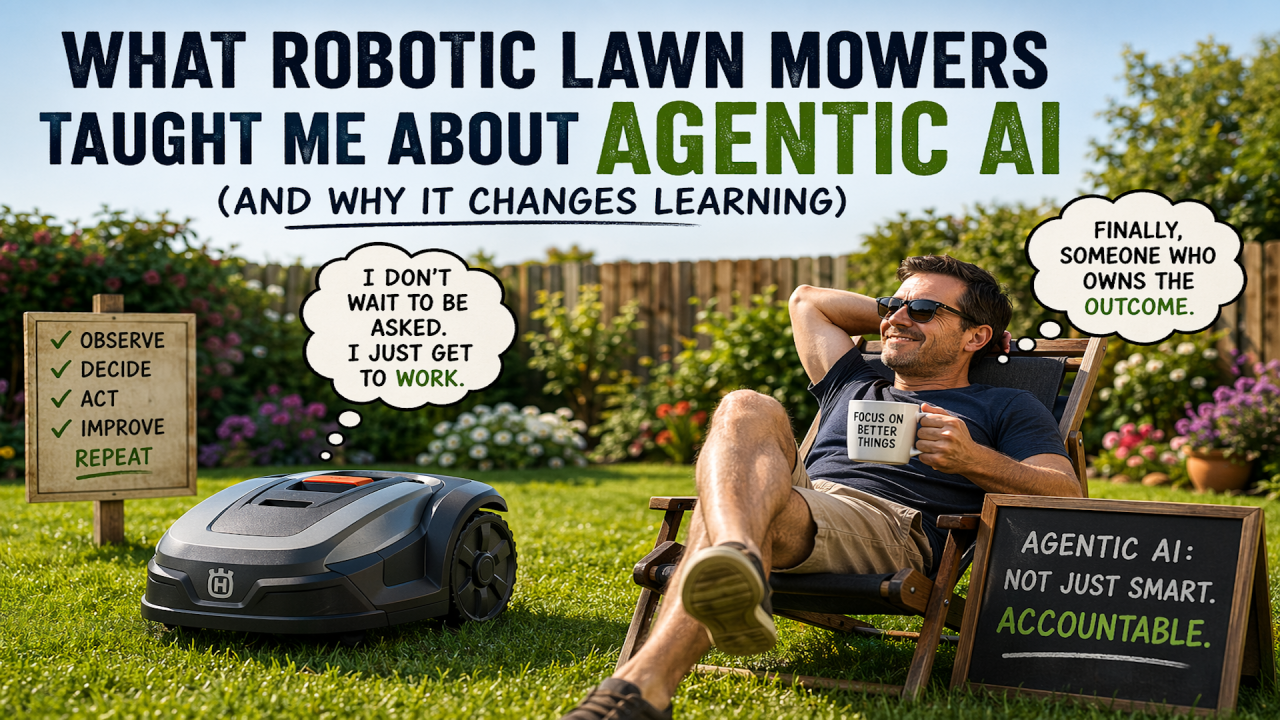
I’m not a particularly good gardener. I like the idea of a well-maintained lawn, but I’ve never really had the time or the discipline to maintain it consistently. Recently, I invested in a robotic lawnmower. Then, shortly after, I purchased a second one, moving from a relatively small coverage area to something that can now manage several thousand square metres.
What’s interesting isn’t the technology itself (although that is interesting to a nerd like me), but the outcome.
The lawn now looks better than it ever has. Not because the machine is more intelligent than I am, but because it has taken ownership of the task. It operates continuously, it responds to its environment, it doesn’t forget, and it doesn’t rely on me remembering to tell it what to do.
That, in essence, is what agentic AI represents.