The Illusion Of Progress: How AI Pilots Get Stuck In POC Purgatory
by James Barton
I recently wrote about a tale of two cars, a sports car and an SUV, to illustrate how different approaches to AI can both have strengths and weaknesses. On one side, some teams build heavy, impressive AI platforms that can scale but struggle to adapt quickly.
On the other side, some teams favour lightweight experiments that move fast and solve immediate problems but often lack staying power and structure. I argued that to truly boost sales performance, organisations need both agility and scalability together; without that, any AI strategy is bound to be either too slow or too fragile.
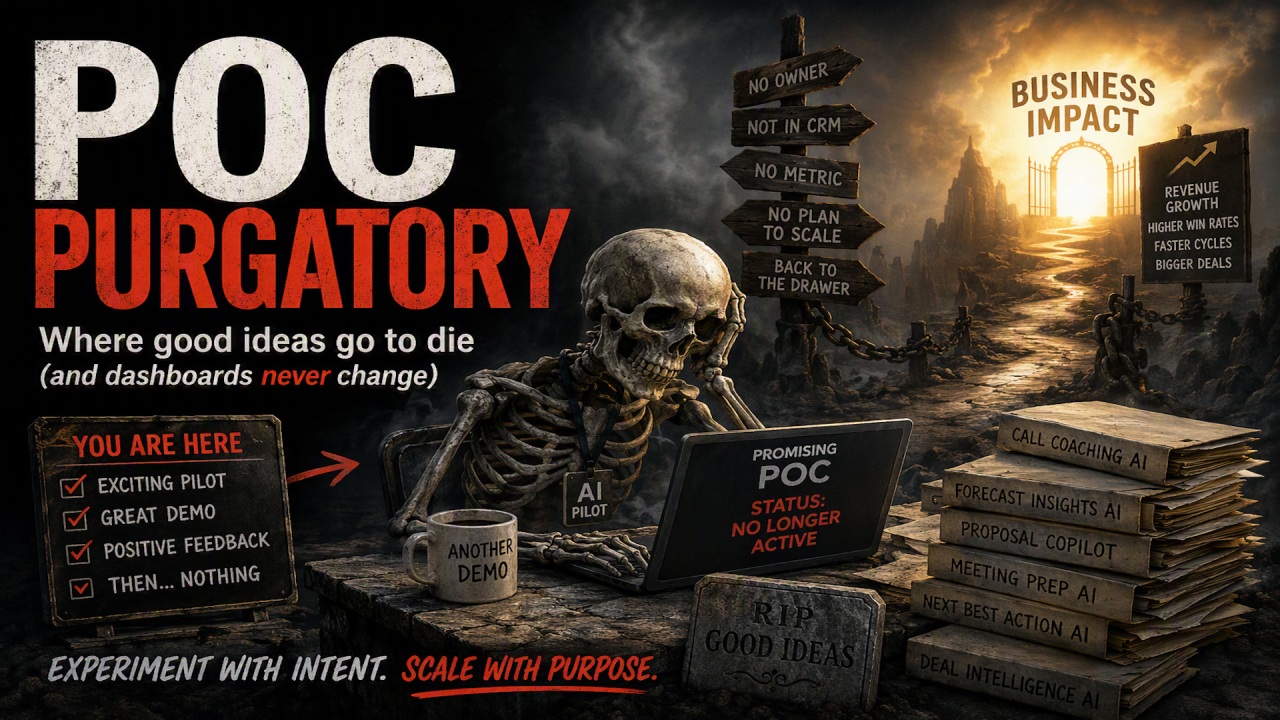
Now I am seeing a worrying pattern across sales enablement where experiments happen constantly but deliver little real change. I call this POC Purgatory, a kind of limbo where promising AI proofs of concept (POCs) and pilot projects remain forever stuck as “projects” and never become real solutions that drive sales outcomes.
Teams excitedly try new tools (often under pressure from the top to deliver an AI project they can take to the board) for call preparation, forecast insights, or proposal drafting. They run small pilots, show a demo or two, and celebrate these early signs of success.
On the surface, it looks like progress, but in practice, nothing has changed, especially when you look at the metrics that matter.
But POC Purgatory is the graveyard of good ideas. The experiments are real and often technically successful: an AI tool can summarise call notes or suggest next steps or even coach sellers. Yet after those trials, everything stops. The pilot ends, the team moves on, and that AI tool never finds a home in the day-to-day life of the sales organisation.
Over time, a business can accumulate a dozen POCs without any of them making a lasting impact on metrics that matter. It is all just activity with no lasting momentum.
So why does this happen? Why do so many AI initiatives in sales enablement end up on an innovation scrapheap?
The answer is rarely the technology itself. In fact, most of these initiatives prove that the tech can work. The problem is how these experiments are framed and managed from day one. Often these pilots are kicked off to answer the question, “Can we do this with AI?” and fail to answer the far more important question: “What will we do with it if it works?”
Far too many proofs of concept are not designed to go anywhere beyond the initial test. They are run in isolation, separate from the core sales systems. They are not tied to a broader enablement strategy or a clear owner in the business. They are rarely linked to a clear commercial metric.
No wonder they struggle to justify the investment to scale up across the whole organisation.
Want to read the full article? Click here