
AI Maturity Is Not About Reaching The Highest Stage
by James Barton
James Barton argued in a recent article that AI maturity in sales enablement should not be treated as a race to the most advanced stage. That got us thinking about a related issue: what if the real sign of maturity is not how much AI an organisation can deploy, but how well it understands which level of AI it can actually use to improve seller performance?
Why the wrong maturity target can slow down progress
There is a strong pull in AI conversations towards the most ambitious version of the future.
Connected systems. Intelligent triggers. Personalised support in the flow of work. Automated coaching. Agentic workflows. Seamless orchestration across sellers, managers, enablement and revenue operations.
It is easy to see why that vision appeals. It sounds efficient, modern and commercially powerful.
But there is a problem with treating that end state as the default destination.
For many organisations, the next best step is not more sophistication. It is more clarity.
James makes this point clearly in his article. AI maturity is often discussed as though it were cumulative: stage one, then stage two, then stage three, then stage four, with each level assumed to be inherently better than the one before. But in practice, maturity is contextual. The right next step depends on the environment, the quality of the data, the strength of the operating model, the role of managers, and the behaviours the business is actually trying to improve.
That changes the conversation entirely.
Instead of asking, “How advanced can we become?”, leaders should be asking, “What level of maturity will genuinely improve performance here?”
Why maturity models become unhelpful when they are treated like ladders
Maturity models are useful when they help leaders understand where they are and what needs to come next.
They become unhelpful when they are treated like scorecards.
Once that happens, the focus shifts from effectiveness to advancement. Leaders start feeling pressure to move upwards because higher stages sound more impressive, not because those stages solve the most pressing commercial problems.
That is where poor decisions start.
James outlines four broad stages in the journey: foundational, connected, responsive and orchestrated. The progression is logical, but the trap is assuming every business should be trying to reach orchestration as quickly as possible.
In reality, some organisations still need stronger foundations. Others need better connection between systems and teams. Some are ready to become more responsive around key commercial moments. Only a small number are genuinely prepared for full orchestration.
That is not a weakness. It is simply context.
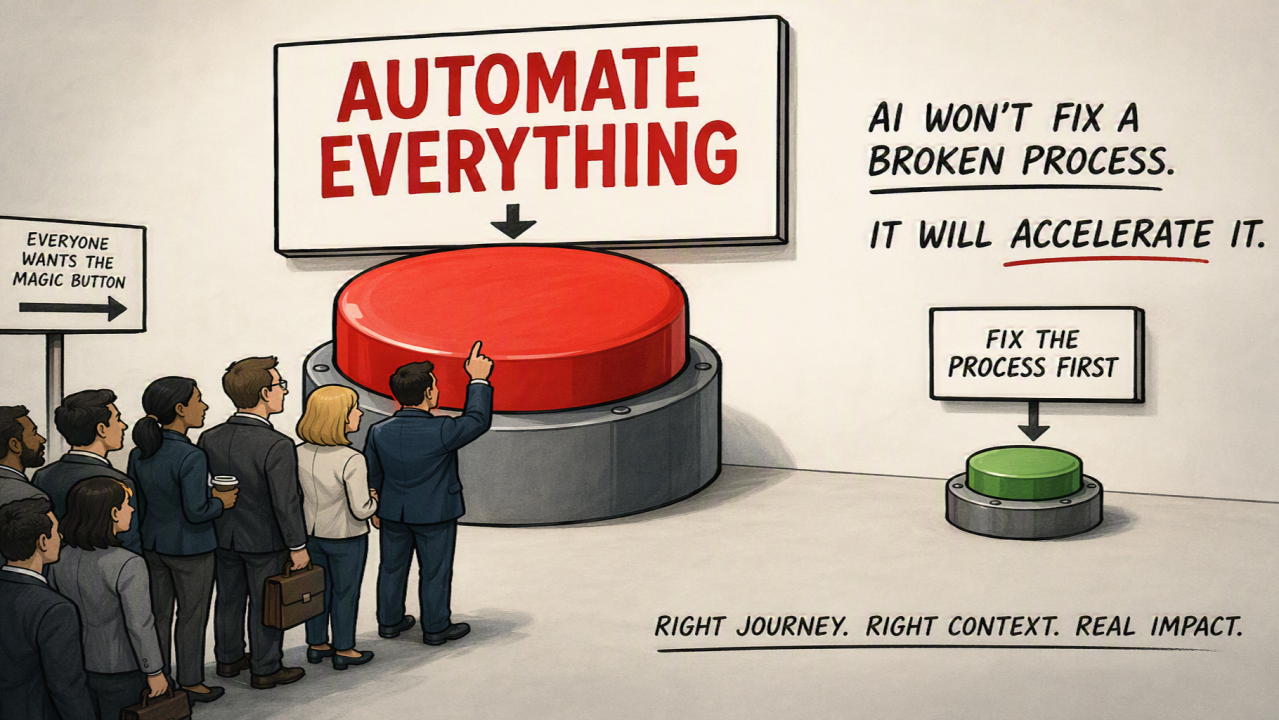
A business with poor CRM hygiene, fragmented content, inconsistent manager coaching and no shared view of what good selling looks like will not become more effective by layering advanced AI on top. It will simply automate noise faster.
The real risk is not moving too slowly
One of the strongest ideas in James’s article is that the biggest danger is often not delay. It is premature automation.
That matters because many AI discussions still assume speed is the main virtue. If something can be automated, triggered or surfaced automatically, the instinct is to move quickly. But speed is only helpful when the underlying process deserves to move faster.
If the capability model is unclear, if content is poor, if managers are not ready to act on coaching signals, or if revenue systems do not reflect how opportunities really progress, then automation does not solve the problem. It scales it.
This is where the phrase from James’s article is especially useful: AI applied to a flawed process does not create a performance lift. It accelerates the confusion.
That is a far better test for maturity than technical capability alone.
The question is not whether the business can automate. It is whether it understands enough about the workflow, the signals and the desired behaviours to automate intelligently.
Four signs your AI maturity ambition is ahead of your operating reality
1. You are talking about orchestration before fixing the basics
If the organisation is discussing agentic workflows and intelligent support, but still struggles with content quality, role clarity or manager consistency, the maturity conversation is running ahead of the work.
2. Your systems are connected in theory, but not trusted in practice
A connected stack is only useful if people trust the data inside it. If sellers treat systems as administration and managers do not rely on the signals they produce, technical integration does not equal operational maturity.
3. You are triggering activity without deciding which moments matter
Not every sales moment deserves interruption, coaching or automation. If the business has not defined which moments truly affect performance, then responsive AI risks becoming constant noise.
4. You are using AI ambition as a substitute for workflow design
Advanced tools can be appealing because they appear to offer progress quickly. But if workflows have not been redesigned, responsibilities are unclear, and process ownership is weak, the technology is being asked to compensate for design problems it cannot fix.
What better maturity planning looks like
A better approach starts by reframing what maturity means.
Maturity is not the accumulation of more tools, more triggers or more autonomy.
It is the ability to apply the right level of AI, in the right places, with the right governance, to improve performance in a way the organisation can sustain.
That means the maturity path will look different depending on the business.
1. Some organisations need to strengthen the foundations
For these teams, the biggest gains will come from clarifying the capability model, improving coaching quality, reducing content clutter and aligning enablement with sales leadership around the behaviours that matter most.
2. Some need to become better connected
For others, the real issue is visibility. If enablement activity cannot be linked to sales outcomes, if CRM stages do not reflect reality, or if RevOps and enablement are working from different assumptions, then connection matters more than automation.
3. Some are ready to become more responsive
These organisations can identify meaningful moments in the workflow and support sellers or managers with relevant prompts, coaching or resources. But even here, judgement matters. The aim is not to respond to everything. It is to respond to the few moments that actually shape outcomes.
4. A smaller number are ready for orchestration
This is where AI can operate with more autonomy across governed data, trusted assets and integrated revenue workflows. But James is clear that this stage requires more than strong ambition. It requires disciplined ownership, reliable source material, robust governance and clear boundaries for where AI should act and where human judgement remains essential.
Why context matters more than sequence
The most important word in James’s article may be contextual.
A regulated enterprise with complex products, long buying cycles and multiple stakeholders will not have the same maturity path as a scale-up with a simpler sales motion. A business with strong process discipline can move more confidently than one where systems are poorly adopted and workflows depend on human workarounds.
That is why maturity cannot be assessed in isolation from environment.
The same AI capability can be high value in one organisation and badly timed in another.
The same trigger can be useful in one workflow and intrusive in another.
The same level of automation can feel supportive in one culture and untrustworthy in another.
Treating maturity as cumulative ignores all of this. It assumes that what is technically possible is automatically what is commercially sensible.
It rarely is.
The questions leaders should ask instead
James closes with a more grounded set of questions, and that is probably the most useful part of the article for any revenue or enablement leader.
Rather than asking how to reach the highest maturity stage, leaders should ask:
1. Where are sellers losing time?
This helps identify whether AI should remove admin, improve access to knowledge, reduce friction or support better prioritisation.
2. Which moments have the greatest effect on performance?
This keeps attention on meaningful points in the sales motion rather than spreading support too widely.
3. Is the data good enough to support reliable recommendations?
Poor signals create poor interventions. AI maturity depends heavily on signal quality.
4. Are managers ready to act on what the system surfaces?
If coaching signals appear but no one uses them well, the issue is not technology maturity. It is management readiness.
5. Which workflows should be redesigned before they are automated?
This is one of the most important tests of all. Automation should improve a sound workflow, not preserve a broken one.
6. What level of AI autonomy would this organisation genuinely trust?
Trust is not a soft issue here. It determines adoption, oversight and how far the business can move with confidence.
The real sign of maturity
The most mature organisations are not necessarily the ones with the most advanced architecture.
They are the ones with the clearest understanding of what they need next.
They know which problems belong to foundations, which belong to connection, which moments justify responsive support, and when orchestration would genuinely add value rather than simply create complexity.
In other words, maturity is not about climbing to the top of the model.
It is about making the next sensible decision.
That is a more demanding standard because it requires restraint as well as ambition. It asks leaders to choose what is appropriate, not just what is possible.
But that is exactly why it is useful.
Because in sales enablement, the goal is not to look advanced.
It is to improve seller capability, manager effectiveness and revenue performance in a way that actually works in the real environment the business is operating in.