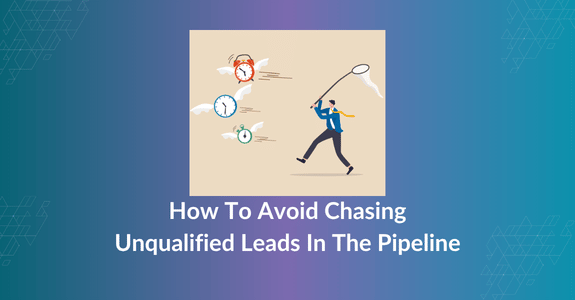
How To Avoid Chasing Unqualified Leads In The Pipeline
by Mentor Group
Chasing unqualified leads is one of the most expensive habits in B2B sales.
It feels like productivity (lots of activity), but it quietly erodes performance: pipeline inflates, stage ageing rises, forecasts become unreliable, and sellers spend their best hours trying to rescue deals that were never real.
If you want to stop chasing unqualified leads, you don’t need harsher policing or more CRM fields. You need clear qualification standards, evidence-based stages, and a cadence that makes “no” a normal outcome.
What an “unqualified lead” looks like in a pipeline
A lead or early opportunity is unqualified when it lacks enough evidence to justify sustained investment.
Common signals:
- No clear buyer problem in the buyer’s language
- No quantified impact (or no route to quantify)
- No known decision process or stakeholders
- No compelling event (no reason to act now)
- Vague next steps (“send info”, “follow up”) with no buyer commitment
- Repeated “interest” without progress through a decision path
The key insight: interest is not qualification.
Why teams end up chasing unqualified leads
This usually isn’t a seller motivation issue. It’s a system issue.
Common causes:
- Targets create pressure to keep pipeline “big”
- Stage definitions are vague, so deals enter too early
- Marketing hand-offs lack context, so sellers guess
- Managers reward activity over evidence
- There’s no “parking” mechanism, so every lead stays active
If you want to stop chasing, you must change what the system treats as progress.
Step 1: Define your minimum qualification evidence (keep it simple)
To avoid chasing, you need a short set of evidence checks that every rep and manager uses.
A practical minimum evidence standard for early-stage opportunities:
- Buyer outcome: what the buyer is trying to achieve (one sentence)
- Impact: time/cost/risk/revenue impact, or an agreed plan to quantify
- Stakeholders: at least a champion and a path to decision-maker
- Decision process: how decisions get made and a rough timeline
- Compelling event: why this matters now (date + business driver)
- Next step: mutual and calendarised (buyer-owned)
You don’t need all of this to open a conversation.
You do need most of it to keep the opportunity “active” and forecastable.
Step 2: Fix the stage hand-off that lets unqualified work into pipeline
Unqualified leads get chased when the pipeline accepts them too early.
Two practical fixes:
1) Tighten stage entry criteria
For your first pipeline stage (e.g., Qualification), define entry criteria in observable terms.
Examples (choose 3–5, not 10):
- Buyer problem recorded in notes
- Next step booked (date/time) with buyer owner
- Initial impact hypothesis captured
- Champion identified (named contact)
2) Add “proof fields” (where evidence lives)
Make it easy to verify qualification:
- Buyer outcome → in a standard note template
- Next step → meeting logged with date/time
- Stakeholders → contacts tagged with roles
This reduces debates and prevents stage inflation.
Step 3: Upgrade next steps (the fastest way to stop chasing)
Chasing thrives on vague next steps.
Set one standard:
- No active opportunity without a mutual, calendarised next step with a named buyer owner.
Replace:
- “Send info”
- “Check in”
- “Follow up next week”
With buyer-anchored actions:
- “Value workshop to quantify impact (Tue 10:00, buyer owner: Ops Director)”
- “Stakeholder mapping session to confirm who signs (Thu 15:00, buyer owner: Project Sponsor)”
- “Security review scheduled; buyer to share questionnaire by Friday (buyer owner: Head of Security)”
If you can’t secure a mutual next step, the opportunity is not under control.
Step 4: Introduce a ‘parking lot’ so you don’t keep everything active
Many leads are real, but not ready.
A parking lot keeps your pipeline credible while preserving future value.
Rules for a healthy parking lot:
- Every parked opportunity has a re-entry trigger (what must happen to reactivate)
- Every parked opportunity has a review date
- Parked deals are excluded from forecast categories
Examples of re-entry triggers:
- Budget approved in next cycle
- New stakeholder starts / restructure completes
- Security requirements confirmed
- Compelling event date agreed
Parking is not failure. It’s pipeline discipline.
Step 5: Time-box early-stage work (stop “infinite nurture”)
Unqualified leads get chased because there is no time limit.
Introduce simple time-box rules:
- If a lead cannot secure a mutual next step within 7–14 days (depending on cycle), park it.
- If key evidence (impact, stakeholders, timeline) isn’t progressing after two interactions, re-qualify or park.
Time-boxing protects seller capacity and forces reality.
Step 6: Make managers coach qualification behaviours (not police fields)
Qualification improves when managers coach the thinking behind it.
Manager prompts that stop chasing:
- “What do we know vs assume?”
- “What is the buyer trying to decide next?”
- “Who signs, and how do we reach them?”
- “What is the compelling event — and what happens if they do nothing?”
- “What’s the next mutual step and when is it booked?”
If managers only ask for updates, sellers will keep leads alive to avoid conflict.
Step 7: Use CRM signals to identify chasing early
Chasing leaves fingerprints in the data.
Track a small set of indicators:
- % early-stage opportunities with mutual next steps
- % opportunities with no activity in X days
- Days in stage for early stages (rising = low qualification quality)
- Stage-to-stage conversion from Qualification to the next stage
- Close date movement (if dates are set early, watch for rapid slip)
When these drift, fix standards and coaching — not spreadsheets.
Common mistakes to avoid
- Turning qualification into a long checklist (creates admin workarounds)
- Confusing interest with intent (polite buyers still say “sounds good”)
- Keeping “maybe” deals in the forecast to feel safe
- Measuring activity without progression
- Skipping stakeholder and decision-path work until late stage
How Mentor Group helps
Stopping the chase is rarely about telling sellers to “qualify better”. It’s about building a pipeline system that rewards evidence and protects capacity.
Mentor Group helps revenue teams:
- Define evidence-based stage standards that prevent premature opportunities entering pipeline
- Upgrade next-step quality so deals are driven by buyer commitments
- Build manager coaching cadences that reinforce qualification weekly
- Introduce practical rules for parking, time-boxing, and stage resets
Our “your way, not our way” approach means we start with how your team sells today and embed standards that fit your motion — so adoption is high and chasing becomes the exception, not the default.
Call to action
If your team is busy but pipeline quality is still low, the fastest improvement comes from tightening the few standards that define “real” and making them coachable.
Get in touch with Mentor Group to explore how to reduce pipeline chasing, improve qualification, and build a pipeline you can trust — without adding unnecessary admin or forcing a rigid methodology.
Summary FAQ
How do I stop sales reps chasing unqualified leads?
Set a minimum evidence standard (outcome, impact, stakeholders, decision path, compelling event, mutual next step), enforce mutual next steps on active deals, and introduce parking with re-entry triggers.
What’s the fastest indicator a lead is unqualified?
No mutual, calendarised next step with a named buyer owner. Vague follow-ups are a strong predictor of stalling.
Should we use BANT to qualify leads?
Frameworks can help, but the practical requirement is evidence. Use a simple evidence checklist that reflects your buying journey rather than forcing a rigid acronym.
What should we do with leads that are interested but not ready?
Park them with a clear re-entry trigger and review date. This preserves future value without inflating the active pipeline.
How long should we keep early-stage opportunities active?
Time-box them. If you can’t secure buyer commitment and progress key evidence within 7–14 days (depending on cycle), re-qualify and park or close out.
What CRM metrics show we’re chasing too much?
Rising days in early stages, low conversion to the next stage, high % of opportunities with vague/missing next steps, and a growing number of stale deals.